

Move-Out Documentation for Furnished Rental Property Management
A reliable move-out process is an essential part of furnished rental property management. When a resident leaves after several months, the inspection covers more than walls and floors. Furniture, linens, kitchen equipment, access devices and appliances all need to be checked against their documented starting condition. Without that comparison, owners can struggle to explain a charge, substantiate a damage claim or understand a turnover expense.
For mid-term rentals, the goal is not to find something to deduct from every security deposit. It is to create a fair, traceable record that separates ordinary use from missing items, resident-caused damage and maintenance needs. That record also helps the next stay begin on schedule. A useful process connects the condition report, supporting evidence, repair decisions and financial closeout rather than leaving them scattered across text messages and contractor invoices.
What move-out documentation proves in furnished rental property management
A complete file should answer three questions: what changed during the tenancy, what supports that conclusion and what action followed?
A photograph of a stained chair establishes its condition when photographed. It does not, by itself, establish when the stain appeared, who caused it or whether replacement is necessary. Those conclusions require context, including the move-in report, maintenance history and an appropriate cleaning or repair assessment.
Keep three decisions separate. The first is operational: what needs attention before another resident arrives? The second is financial: who should bear an eligible expense? The third concerns protection: whether a loss may qualify under an insurance policy or damage-protection arrangement.
A turnover expense is not automatically a resident charge. Replacing an aging mattress may be sensible for the property even when there is no basis for deducting its cost from a deposit.
Assemble the baseline before the resident leaves
Start with the signed lease, move-in condition report, inventory and any resident-submitted corrections. Add records of repairs, approved furniture changes and items removed or replaced during the stay. If a lamp was discarded with management's permission, the original inventory alone could wrongly suggest that it disappeared.
Owners who need a stronger starting record can use an inventory checklist for furnished apartments to establish item identifiers and condition notes. At move-out, the task is to reconcile that record, not create a new inventory from memory.
Send clear departure instructions covering the agreed surrender process, key returns, personal belongings and the forwarding-address request. Distinguish required resident responsibilities from optional requests, and do not introduce new fees or cleaning obligations that were absent from the agreement.
Good furnished rental property management also preserves communications about preexisting defects. A message reporting a loose dining-chair leg early in the tenancy may materially change how that chair should be assessed at departure.
Inspect in a consistent order
Confirm possession and handle access carefully
Record when and how possession was surrendered, including returned keys, access cards and garage remotes. An early departure, unanswered message or missed appointment does not necessarily establish legal surrender. Follow the lease and applicable law before entering, changing access or handling belongings left behind.
Once access is authorized, inspect before routine cleaning or repairs change the evidence. Address urgent safety issues promptly, documenting the condition first when it is safe to do so. Record who entered the property and when, including cleaners and contractors, so later observations have a clear timeline.
Capture context before close-ups
Photograph each room from consistent viewpoints, then capture individual items and any concerns. A wide image establishes location; a medium view identifies the item; a close-up records the detail. Include a ruler or another clear reference when size matters.
For furnished rental property management, this sequence is especially useful when several similar items are present. “Bedroom chair” is ambiguous if the home contains four matching chairs. An inventory identifier connects the photograph to the correct item and its earlier condition.
Preserve original files and their metadata. Avoid filters, enhancements or annotations that obscure the original evidence; use separate copies if labels are needed. A short walkthrough video can supplement photographs, but it should not replace clear still images of individual issues.
Record limitations honestly. If an appliance was not tested or a mattress area could not be inspected safely, mark that limitation rather than reporting the item as fully checked.
Write observations rather than accusations
Describe what is visible before assigning a cause. “Three-inch split along the left cushion seam” is more useful than “resident ruined sofa.” Distinguish direct observations from resident statements and contractor opinions.
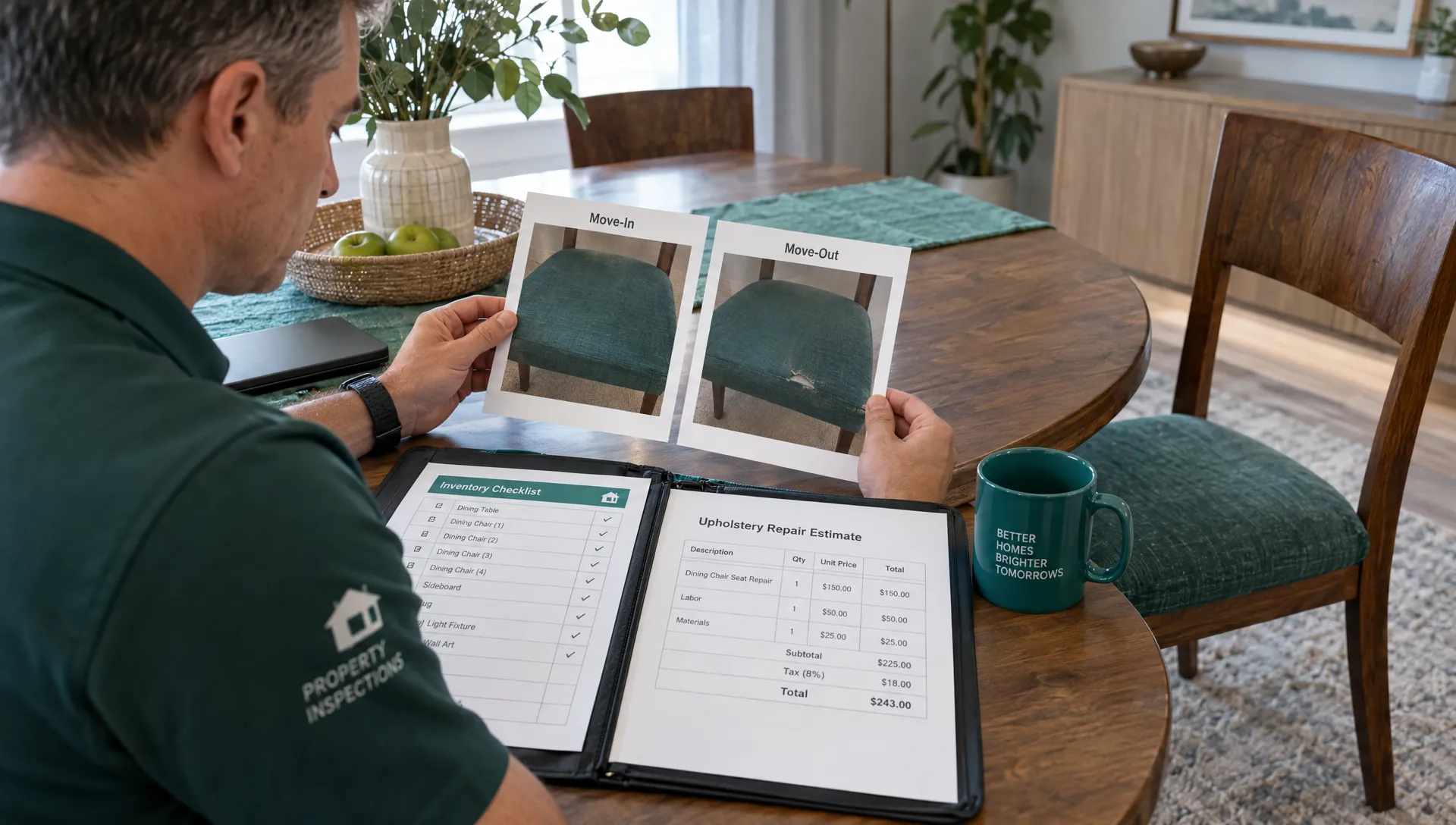
A useful entry might read: “Living room, sofa LR-02: split at left seat seam. Move-in image LR-02-A shows the seam intact. Upholstery assessment requested to determine whether repair is practical.”
Record the resident's explanation when available, including any disagreement. Their signature can acknowledge receipt of a report without necessarily establishing agreement with every finding. Do not describe an unsigned report as accepted.
Separate ordinary wear from potentially chargeable damage
Months of normal occupancy leave evidence of use. Light surface wear, gradual fabric fading and age-related failures should not be treated the same way as missing furnishings or damage beyond ordinary use.
The distinction depends on the starting condition, tenancy length, item age, lease and applicable law. In furnished rental property management, a consistent decision process is more defensible than an automatic replacement fee applied whenever an item looks less than new.
| Observation | Questions to resolve | Useful supporting records |
|---|---|---|
| Sofa fabric looks faded | Is this gradual aging or a distinct new stain? | Earlier photographs, item age and cleaning assessment |
| Dining chair is missing | Was it present initially or removed with permission? | Signed inventory and change records |
| Cooktop is cracked | Was the crack preexisting, caused by impact or associated with another failure? | Move-in images and technician findings |
| Mattress has a new stain | Is professional treatment effective, and what condition existed before the stay? | Condition report, photographs and treatment assessment |
Do not assume that every broken item proves misuse. Likewise, do not classify all accidental damage as ordinary wear. Document the facts first, then apply the relevant standard.
Establish a supportable cost
Once the condition is documented, determine the appropriate remedy. Cleaning, repair and replacement are different decisions, and replacement is not always justified because it is easier to arrange.
Obtain an itemized estimate or invoice that identifies the affected item, proposed work and cost. If an estimate supports an initial decision, retain the final invoice when the work is completed and reconcile any difference.
A loss record should account for preexisting condition, age and remaining useful life where relevant. Charging the full price of a new premium sofa for damage to an older basic model can overstate the loss. Do not use an arbitrary depreciation schedule as though it were a universal legal rule; apply the governing requirements and obtain advice when the valuation is disputed.
Cost documentation in furnished rental property management should also distinguish damage remediation from owner upgrades. If a damaged chair is replaced as part of a decision to purchase an entire dining set, explain why the additional purchase was made rather than automatically attributing the whole expense to the resident.
Record any related recovery from another source. The same loss should not be collected twice through a deposit deduction and a protection payment.
Close the security deposit file on the legal timeline
For Houston-area owners, Texas law matters more than a generic online checkout checklist. Under Texas Property Code Sections 92.103 through 92.107, a residential landlord generally must refund a security deposit on or before the 30th day after the tenant surrenders the premises, subject to the statutory requirements and exceptions.
The statute addresses deductions for damages and charges for which the tenant is legally liable, prohibits withholding for normal wear and tear and generally requires a written description and itemized list when deductions are made, subject to an exception. A tenant's written forwarding address also affects the landlord's obligation to provide the refund and accounting. Failure to provide that address does not forfeit the tenant's entitlement.
For furnished rental property management, maintain a deadline log separate from the repair schedule. Record the surrender date, receipt of the written forwarding address, applicable accounting deadline, amount returned and evidence of delivery. Do not assume that waiting on a contractor or protection claim extends a statutory deadline.
Have Texas counsel confirm which rules apply to the agreement rather than assuming a furnished or shorter-duration stay is exempt. This overview is not legal advice, and a disputed deduction deserves case-specific review.
Build a separate damage-protection or insurance file
A deposit accounting and a protection claim may use overlapping evidence, but they are not interchangeable. A photograph sufficient to explain a repair to an owner may not satisfy a provider's claim requirements.
Check notice deadlines and required documentation promptly. Preserve the lease, baseline condition records, dated observations, repair assessments and relevant communications. If emergency work requires disposal of an item, document it thoroughly and check whether the provider requires inspection or other steps before disposal when circumstances allow.
Scott Property Management includes up to $1 million in property damage protection as standard risk protection. Owners should confirm the applicable terms, exclusions, claim deadlines and documentation requirements rather than assuming every missing or damaged item qualifies.
Strong furnished rental property management keeps the amount requested, supporting costs, claim status and any payment clearly identified. A pending claim should remain labeled pending; it is not confirmed income or a guaranteed reimbursement.
Give the owner a concise closeout packet
Owners should not have to reconstruct a tenancy from dozens of attachments. Create a summary that links each issue to its evidence, decision and current status. Keep detailed files available without burying the main conclusions.
A practical closeout packet contains:
- Possession record: Surrender details, returned access devices and unresolved belongings or access issues.
- Condition comparison: Relevant move-in and move-out evidence, with item identifiers and inspection limitations.
- Decision log: Ordinary wear, maintenance needs, potential resident responsibility and the reasoning for each classification.
- Financial reconciliation: Estimates, final invoices, deposit accounting, owner expenses and any protection recoveries.
- Turnover status: Work completed, outstanding tasks and the person responsible for confirming readiness.
This is where furnished rental property management should connect documentation with operations. A scheduled repair is not a completed repair, and a cleaned room is not necessarily ready if a required safety check remains outstanding. Keep the next occupancy decision separate from the financial dispute.
Clear owner communication workflows can make these updates easier to follow. Store the underlying records securely, limit access to people who need them and follow an appropriate retention schedule. Avoid unnecessarily capturing personal paperwork, account information or other resident data in inspection images.
Frequently asked questions
Are move-out photos enough to support a deduction? Usually, photographs need context. A stronger file connects the image to the move-in condition, lease obligations, cause assessment and a supportable cost. Photos alone may not establish responsibility or justify replacement.
Should residents attend the move-out inspection? An agreed appointment can help clarify observations and record explanations. Follow applicable access requirements and any relevant lease terms. Do not treat attendance, silence or refusal to sign as automatic agreement with charges.
How does furnished rental property management handle an item with no move-in record? Document the uncertainty and search for other reliable evidence, such as purchase records, earlier photographs or maintenance communications. Do not present an undocumented starting condition as an established fact.
Can turnover cleaning always be deducted from the deposit? No. Routine preparation for the next resident is not automatically a chargeable loss. Any proposed deduction needs a valid basis under the agreement and applicable law, supported by the actual circumstances and cost.
Discuss your mid-term rental's move-out process
A well-documented departure helps protect the property without turning every turnover into a dispute. It also gives owners a clearer view of maintenance needs, resident responsibility and the true cost of preparing for another stay.
If you own a furnished mid-term rental in the Houston area, contact Scott Property Management to discuss your property and ask how move-out inspections, deposit accounting and damage-protection documentation would be handled.