

How to Research the Mid Term Rental Market Before Buying
Buying a furnished rental because nearby listings advertise attractive monthly rates is an expensive shortcut. Researching the mid term rental market means checking who needs temporary housing, what comparable properties actually offer and whether realistic revenue covers your ownership costs. For Houston investors, the strongest purchase is not necessarily the home with the highest advertised rent. It is the property with identifiable demand, manageable expenses and a workable backup plan if bookings fall short.
The goal is to replace an optimistic rental estimate with evidence before you commit to a purchase.
Start with a specific renter and location
Mid-term rentals generally accommodate stays lasting roughly one to six months, although definitions vary by platform, lease and jurisdiction. These guests need more than a furnished place to sleep. They need housing that works for daily life during a temporary assignment, relocation or displacement.
Before browsing properties, choose the renter profile you intend to serve. A traveling healthcare professional may prioritize a practical commute and quiet sleeping conditions. A relocating household may need multiple bedrooms, parking and room for pets. Someone displaced by home repairs may need flexible extensions rather than a fixed departure date.
In Houston, investigate employment and housing needs around locations such as the Texas Medical Center, the Energy Corridor or the specific workplace your intended renters use. Proximity alone does not establish demand. Test the actual commute at relevant times, including shift changes where applicable.
Write a short investment hypothesis: “This two-bedroom property will serve relocating households who need furnished housing near their workplace.” That statement gives your research a focus and helps you reject homes that do not fit.
Build a mid term rental market comparison sheet
Collect a working sample of roughly 10 to 15 furnished properties that serve the same renter and location. This is a research starting point, not a statistically representative sample. Expand it if listings differ substantially or the area has limited supply.
Search platforms such as Furnished Finder, monthly-stay listings and local furnished housing providers. Use the same intended dates and stay length wherever possible. A rate shown for an unspecified month may not reflect the period you are underwriting.
Record enough information to compare the complete offer:
| Comparison field | What to capture | Why it matters |
|---|---|---|
| Location | Neighborhood and realistic commute | Tests suitability for the intended renter |
| Property configuration | Bedrooms, bathrooms and property type | Keeps comparisons relevant |
| Monthly housing cost | Rent, required fees and utility arrangements | Reveals what the renter actually pays |
| Minimum stay | Required duration and extension terms | Shows whether the offer fits temporary housing needs |
| Practical amenities | Laundry, parking, internet and pet policy | Helps explain differences in price |
| Availability | Open dates and listing changes over time | Provides clues that require further verification |
Separate close substitutes from premium outliers. A detached home with a fenced yard is not directly comparable to a smaller apartment simply because both have two bedrooms.
For every comparable, note the date you checked it. Listing information changes, and an undated screenshot becomes less useful as your purchase decision approaches.
Verify demand instead of treating listings as bookings
An asking price is evidence of an owner's expectations, not proof of collected revenue. A credible mid term rental market assessment needs more than a spreadsheet of advertised rents.
Track your comparison properties over several weeks when your buying timeline allows. Note price reductions, changes in minimum stay and repeated availability. An unavailable date could represent a booking, an owner block or a calendar that is not maintained. Do not label it occupied without confirmation.
Speak with local furnished rental operators, property managers and relocation professionals. Ask which property types receive inquiries, what stay lengths are common and whether demand varies through the year. Request the basis for any occupancy estimate, including the period measured and the number of properties represented.
Distinguish inquiries from signed leases and signed leases from completed, paid stays. If someone shares performance figures, ask whether they reflect collected rent, concessions, cancellations and gaps between residents.
Look for multiple independent demand sources. A property that depends on one employer, one referral relationship or one temporary project has a narrower margin for error than one suited to several renter groups.
Check whether the intended use is permitted
Legal and contractual restrictions can make an otherwise promising mid term rental market irrelevant to a particular property. Complete this review before relying on rental income in your purchase decision.
Obtain the actual deed restrictions, HOA documents and condominium rules where applicable. Check minimum lease terms, rental caps, approval procedures and restrictions on furnished or corporate housing. Do not rely solely on the seller's statement that rentals are allowed.
Also confirm applicable city and county requirements, the proposed lease structure and any tax obligations with qualified local professionals. A stay exceeding 30 nights is not a universal exemption from regulation, insurance conditions or private restrictions.
Ask your lender whether the planned use fits the loan terms. Obtain written insurance quotes describing the property's furnished rental use, expected stay lengths and relevant liability coverage.
Jurisdiction-specific advice matters for overseas purchases too. For example, an investor considering property in Eindhoven would consult local counsel handling rental-law matters rather than apply Texas lease assumptions to a Dutch property.
For a Houston purchase, use Texas-qualified counsel to review unresolved lease or restriction questions. Include appropriate document-review and inspection protections in the offer with guidance from your real estate and legal advisers.
Underwrite collected revenue, not the advertised monthly rate
The financial test for a mid term rental market opportunity is whether conservative collected revenue supports the purchase price and operating costs. Calculate annual revenue using paid occupancy, then account for expenses incurred even while the property is empty.
The following example is illustrative, not a Houston market forecast or Scott Property Management fee quote. It assumes $3,600 per occupied month, 10 paid months and no HOA dues.
| Annual item | Illustrative amount |
|---|---|
| Collected rent | $36,000 |
| Mortgage principal and interest | $18,000 |
| Property taxes and insurance | $7,200 |
| Owner-paid utilities and internet | $3,600 |
| Management at an assumed 10% of collected rent | $3,600 |
| Maintenance and furnishing replacement reserve | $2,400 |
| Four owner-paid turnover cleanings at $200 each | $800 |
| Cash flow after listed costs | $400 |
That apparent $3,600 monthly rental opportunity produces only $400 in annual cash flow under these assumptions, before income taxes and unlisted expenses.
Keep acquisition costs separate: down payment, closing costs, initial repairs, furniture, housewares and setup expenses all require capital. Review operating performance separately from financing because loan terms can change cash flow substantially.
For actual estimates, obtain property-specific insurance quotes, utility information, management terms and repair bids. Check property tax records and applicable exemptions rather than assuming the seller's current tax bill will remain yours.
Stress-test vacancy, pricing and unexpected costs
A mid term rental market can support attractive asking rents without supporting your required return. Test what happens when the property performs below your base case.
Using the same illustrative example, one fewer paid month reduces collected rent by $3,600. The assumed management expense falls by $360, but all other listed costs are held constant for this sensitivity test. Annual cash flow drops from $400 to negative $2,840. An additional occupied month raises it to $3,640 under the same assumptions.
Actual utility and turnover costs may change with occupancy, so refine the model once you have better information. Also test a lower monthly rent, a large repair and a longer gap between residents. Avoid combining premium pricing, unusually high occupancy and minimal maintenance in the same base case.
Calculate the reserve needed to carry the home through your downside scenario. Then compare the property with a conventional unfurnished rental alternative. A fallback lease should be evaluated using its own achievable rent, expenses and restrictions, not treated as an automatic rescue.
If the deal only works under optimistic assumptions, revisit the purchase price or pass.
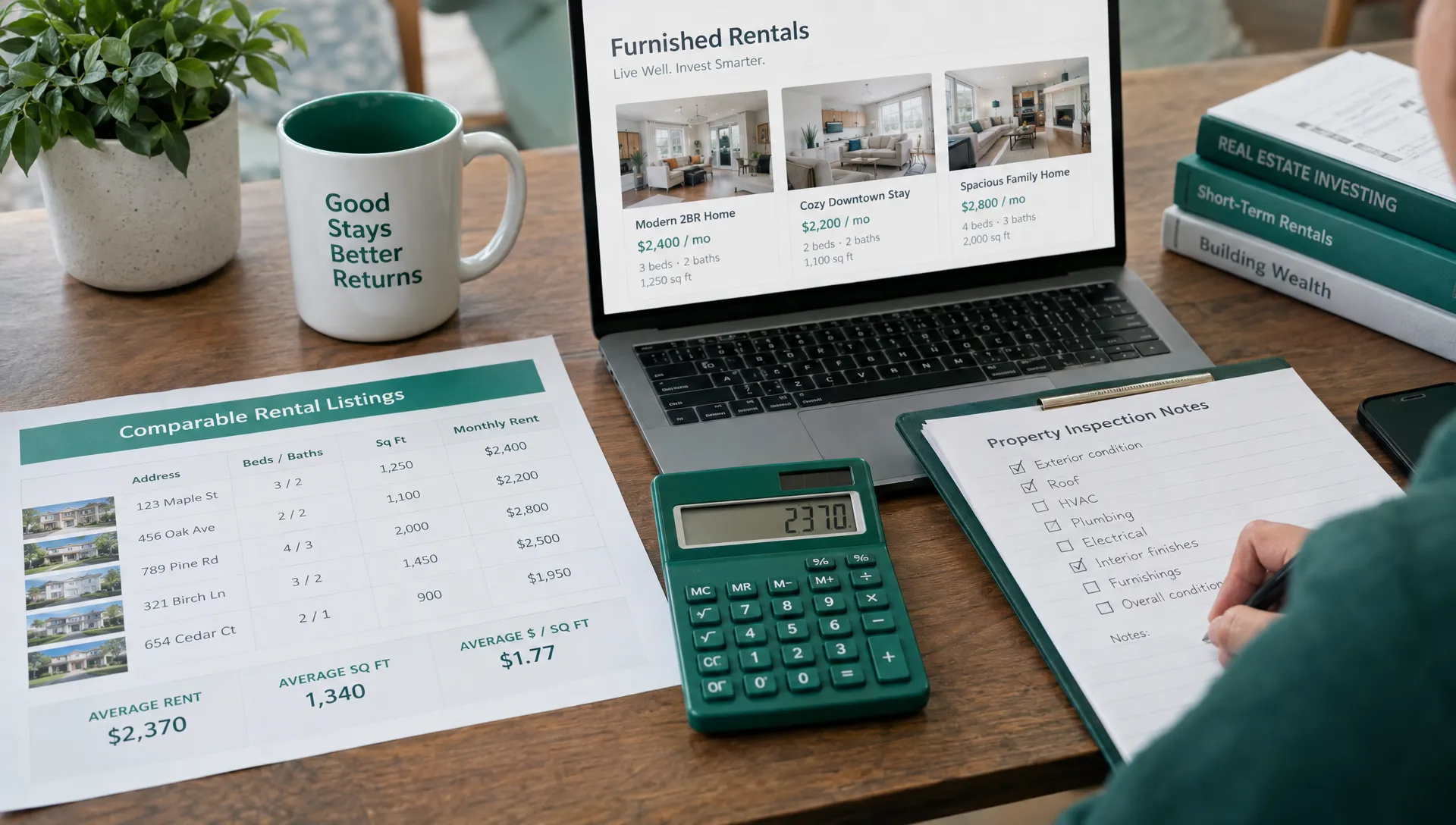
Inspect the property for furnished rental suitability
A standard inspection is essential, but your due diligence should also address the daily needs of temporary residents. Consider laundry access, reliable internet availability, parking arrangements, storage and the condition of furnishings included in the sale.
Inspect expensive systems carefully. In Houston, air-conditioning condition and performance deserve close attention. Evaluate roof condition, drainage and evidence of prior water intrusion with appropriate professionals.
Review the FEMA Flood Map Service Center, obtain available flood-history disclosures and discuss coverage with an insurance professional. A mapped flood designation is one part of the assessment, not a complete prediction of future water damage.
Ask contractors to price near-term work before your inspection period expires. A home needing major repairs may lose rental time as well as consume cash. Distinguish cosmetic improvements from work necessary to make the property safe and functional.
Property condition can change your mid term rental market analysis because a higher advertised rent may require upgrades that erase the expected return. Price those improvements instead of assuming furnishing alone will justify a premium.
If outsourcing upkeep is part of your plan, evaluate how to choose a property maintenance company for rentals before finalizing your operating budget.
Set purchase criteria before negotiating
Turn your research into a short written decision memo. Include the intended renter, comparable properties, verified restrictions, base-case cash flow, downside cash flow and initial capital requirement. Mark every unresolved assumption clearly.
Use that memo to establish your maximum purchase price. If the seller's price requires rent above the closest substitutes or occupancy you cannot substantiate, the problem is not solved by a more polished listing.
Useful reasons to pause or decline include:
- Restrictions that conflict with your planned lease lengths or rental use.
- Demand supported only by advertised prices, without independent verification.
- Insurance or repair costs that materially weaken the downside case.
- Insufficient reserves after closing and furnishing the property.
- A fallback rental strategy that also fails your financial requirements.
Your mid term rental market research should also identify who will execute the operating plan. Ask prospective managers how they establish pricing assumptions, report collected revenue and handle gaps between residents. These questions to ask a rental management company before signing can help you evaluate proposals without confusing projected gross rent with owner proceeds.
Recheck key comparables, insurance quotes and unresolved restrictions before closing. Research completed early in the search may no longer reflect the property or competitive conditions you are buying into.
Frequently asked questions
How many comparable properties should I research? Start with roughly 10 to 15 relevant furnished properties, then expand the sample if they vary widely. Similarity matters more than volume. Match location, property type, bedroom count, stay length and included services as closely as possible.
Can I use Airbnb nightly rates to estimate monthly rental income? Not by simply multiplying a nightly rate by 30. Monthly discounts, fees, seasonal pricing and booking gaps can change the economics. Search for the intended stay length and compare the renter's complete cost.
How do I know whether an area has enough temporary housing demand? Validate the mid term rental market through several sources: comparable listings tracked over time, conversations with local operators and identifiable reasons people need temporary housing. Employer proximity is useful context, but it is not proof of bookings.
Should I buy before speaking with a property manager? A pre-purchase conversation can help test pricing, property suitability and operating assumptions. Treat estimates as inputs to your own underwriting, not guarantees, and ask what evidence supports them.
Discuss the property before you buy
Before committing to a furnished rental purchase, bring your comparable-property research, cost estimates and downside scenario to Scott Property Management. The company specializes in furnished rentals and provides up to $50,000 in property damage protection as standard risk protection. Ask about the applicable coverage terms and how the property fits your intended rental strategy. Sound research should guide the purchase, not justify it afterward.