
How to Build a Rental Maintenance Cost Reserve
A rental maintenance cost reserve is money you set aside before a repair bill arrives. For a furnished mid-term rental, it should account for more than plumbing leaks and HVAC service. Appliances, mattresses and furniture also need eventual replacement, even when longer stays reduce turnover work.
The most useful reserve separates predictable upkeep, future replacements and unexpected repairs. That gives you a monthly funding target without confusing money in the bank with profit you can safely distribute. Here is how to build that target around your property's actual condition.
Separate maintenance spending from reserve savings
Start by deciding what belongs in each budget category. Otherwise, the same expense can appear in both your operating budget and your reserve calculation.
| Category | Examples | Budget treatment |
|---|---|---|
| Routine maintenance | HVAC servicing, pest prevention, minor plumbing repairs | Forecast annual spending and fund it monthly |
| Major replacements | Roof, HVAC equipment, water heater | Build a dedicated replacement balance over time |
| Furnishing replacements | Mattresses, sofas, dining chairs | Track separately from building systems |
| Unexpected repairs | Sudden leaks, electrical faults, appliance breakdowns | Maintain an accessible emergency cash balance |
| Other operating expenses | Utilities, management fees, turnover cleaning | Budget separately unless explicitly included in your calculation |
Your rental maintenance cost reserve is a cash-management tool, not a tax category. Transferring money into a savings account generally does not create a tax deduction. The eventual expense determines its treatment.
The IRS guidance on residential rental property distinguishes repairs from improvements that generally must be capitalized and depreciated. Furniture and equipment can also require separate tax treatment. Have your tax professional classify actual expenditures rather than assuming every withdrawal is immediately deductible.
For the broader operating picture, incorporate this reserve into your budget for a furnished mid-term rental, rather than treating it as an additional version of the same expenses.
Inspect the property before choosing a monthly amount
A percentage of rent cannot tell you whether a water heater is close to failure. Before setting your contribution, record each major asset's age, condition, warranty status and likely remaining service life.
For an inherited home, missing maintenance records deserve particular attention. Equipment that works today may still need near-term replacement. Have qualified contractors assess uncertain systems instead of assigning them a full new service life.
In Houston, include cooling equipment, condensate drainage, roof condition and moisture-related problems in the review. Obtain local quotes because access, installation requirements, permits and labor can materially change the final bill.
Use the inspection to divide work into three timelines: repairs needed before occupancy, likely expenses within the next year and longer-term replacements. Known urgent work needs immediate funding, not a slow savings plan.
This condition review makes your rental maintenance cost estimate property-specific. A recently renovated condo and an older detached house should not automatically receive the same monthly allowance simply because they collect similar rent.
Calculate your rental maintenance cost reserve in three parts
Use this working formula:
Monthly funding target = annual routine maintenance ÷ 12 + monthly replacement contributions + temporary emergency-fund contributions.
The following example uses hypothetical planning amounts, not Houston market quotes. Replace every assumption with your own records, inspections and contractor estimates.
Part 1: Estimate routine annual spending
Suppose you forecast $1,800 annually for scheduled service and minor repairs. Your monthly contribution is:
$1,800 ÷ 12 = $150 per month.
Base this forecast on actual invoices when available. Separate recurring service contracts from irregular repairs, then adjust for current pricing and any change in property condition.
For a furnished mid-term rental, account for maintenance during occupied stays as well as between residents. Fewer turnovers can reduce cleaning and reset work, but they do not eliminate equipment use or the need to arrange service access.
Part 2: Build replacement funds asset by asset
For each asset, calculate:
Monthly replacement contribution = (estimated replacement cost − money already earmarked) ÷ months until replacement.
Here is an illustrative schedule:
| Asset | Estimated future replacement cost | Already earmarked | Planning horizon | Monthly contribution |
|---|---|---|---|---|
| HVAC equipment | $7,200 | $1,200 | 60 months | $100.00 |
| Water heater | $1,800 | $0 | 36 months | $50.00 |
| Kitchen and laundry appliances | $2,400 | $600 | 48 months | $37.50 |
| Selected furnishings | $3,000 | $600 | 48 months | $50.00 |
| Roof | $12,000 | $3,000 | 120 months | $75.00 |
| Total | $26,400 | $5,400 | Varies by asset | $312.50 |
These horizons are assumptions for this example, not promises about equipment lifespan. Replacement estimates should include installation, removal and other applicable costs. Revisit longer-range figures annually as prices change.
Your rental maintenance cost calculation should also reflect ownership responsibilities. For a condo, confirm which components the association maintains, then consider any separate exposure to special assessments. Do not reserve for an entire roof replacement if that obligation does not belong directly to you.
Part 3: Set an emergency cash target
An emergency reserve is a balance to maintain, not an expense you automatically incur every year. Choose it by considering plausible urgent repairs, contractor callout costs and how quickly you can access additional cash.
Suppose you select a $3,000 target for unexpected repairs and already have $1,800 available, separate from the replacement funds above. The $1,200 gap requires $100 per month to close over one year.
Your initial monthly funding target becomes:
$150 routine maintenance + $312.50 replacements + $100 emergency funding = $562.50 per month.
After the emergency balance reaches its target, the ongoing contribution falls to $462.50, assuming nothing else changes. Replenish the emergency fund after withdrawals.
That schedule does not mean $1,800 can cover a $3,000 bill tomorrow. If the exposure requires immediate protection, make an upfront deposit or establish another reliable funding source. Keep vacancy cash and any separately budgeted insurance deductible outside this example so they are not counted twice.
Test the reserve against rent, vacancy and timing
The example requires $6,750 in contributions during the first year. If you expect to collect rent during only 10 months, you would need to allocate $675 from each rent-producing month to reach that annual target.
That is a funding calculation, not a prediction that repairs occur only during occupied months. An HVAC service appointment or roof leak can happen while the home is vacant.
Check your rental maintenance cost plan against a month-by-month cash forecast. A yearly total may look sufficient while leaving you short before the first booking or during a seasonal spending peak.
Keep a separate vacancy reserve for obligations such as mortgage payments, insurance, taxes and utilities. If your overall cash cushion already includes maintenance, label that allocation clearly rather than adding a second allowance for the same bills.
Mid-term stays can make income and turnover schedules more predictable than frequent short bookings, but departures can still cluster maintenance work. Inspect before renewing your forecast, particularly when a resident reports an issue that may worsen before the next scheduled visit.
Keep the reserve usable and avoid double counting
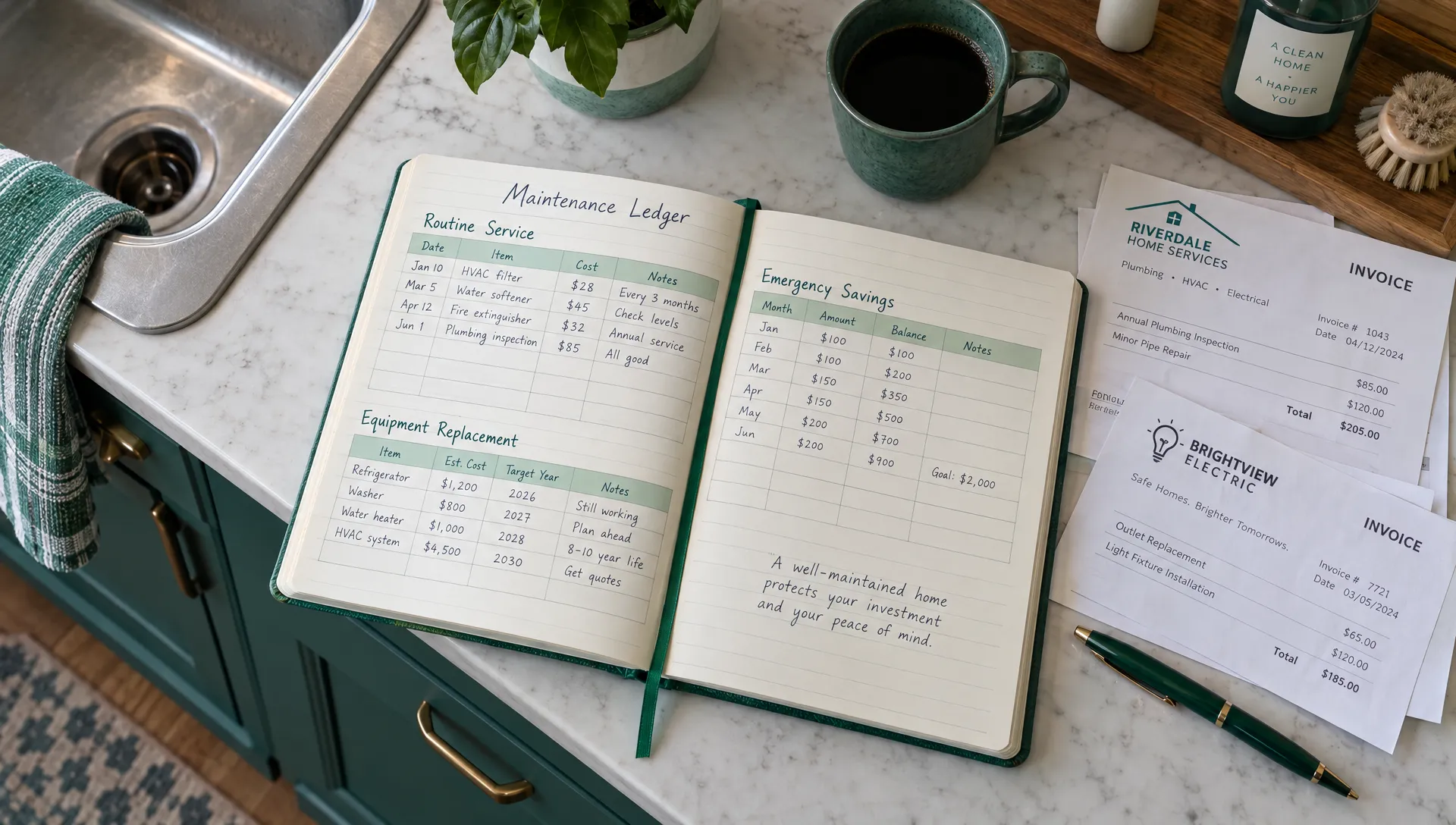
Use a dedicated account or clearly separated bookkeeping balances so reserve money does not disappear into ordinary spending. Track routine maintenance, replacement funds and emergency cash independently, even if they share one bank account.
Schedule transfers consistently. A monthly automatic transfer works well when receipts are steady; uneven income may require larger transfers during occupied months. Review balances quarterly and after any significant repair.
A useful rental maintenance cost ledger records the property, asset, opening balance, contribution, withdrawal and remaining balance. It should also show the next expected expense date.
Apply a few accounting safeguards:
- Assign every dollar once: Money earmarked for the roof cannot simultaneously count toward your emergency cash target.
- Classify each invoice once: If an emergency replacement uses an asset's existing fund, record the emergency fund as covering only the shortfall.
- Keep tenant deposits separate: Security deposits are not freely available owner maintenance savings and remain subject to applicable law.
- Record reimbursements when received: Do not assume a pending insurance or damage claim will pay a contractor's current invoice.
If you use a property manager, reconcile your owner-held reserve with any maintenance balance the manager holds. Confirm whether those amounts overlap before deciding how much additional cash to retain.
Use contractor quotes to refine repair-or-replace decisions
A reserve estimate improves when contractor proposals describe the same scope. Ask whether each quote includes diagnosis, labor, materials, permits where required, disposal and warranty coverage. A lower headline price may omit work another contractor included.
When deciding between repair and replacement, compare the immediate repair bill with expected additional repairs, remaining service life and the consequences of another failure. A repair that buys several reliable years differs from one that merely delays an already necessary replacement.
For a furnished rental, also consider access coordination and potential disruption to the resident. Those practical costs matter, even when they do not appear on the invoice.
Ask for an explanation of the failure and whether the proposed work addresses its cause. Our guide to choosing a property maintenance company for rentals covers additional questions for evaluating service providers.
After approving work, update your rental maintenance cost forecast. A new system may change its replacement timeline, while repeated failures may justify bringing a planned replacement forward.
Frequently asked questions
Is $300 a month enough for rental maintenance? It provides $3,600 annually, but adequacy depends on condition, repair history and existing savings. In the example above, routine maintenance and replacement contributions total $5,550 annually before emergency-fund contributions. A newer property with well-funded reserves could need less.
What is the 50% rental rule? It is a rough screening guideline that assumes operating expenses consume about half of gross rental income, generally excluding mortgage principal and interest. It is not an instruction to save half the rent for maintenance. Property-specific expenses are more useful for setting an actual budget.
Can I use a 1% or 2% rule instead? Setting aside 1% to 2% of property value annually is sometimes used as a maintenance benchmark, but land value and local pricing can distort it. The separate “2% rule” used in investment screening compares monthly rent with purchase price; it is not a maintenance-reserve formula.
Does damage protection replace a maintenance reserve? No. Review the actual coverage terms, exclusions and claims process. Do not assume protection pays for ordinary wear, aging equipment, preventive service or every resident-related loss.
Can repairs wait until the reserve has enough money? Not when applicable law requires action. For covered residential tenancies, Texas Property Code Section 92.052 addresses certain conditions materially affecting an ordinary tenant's physical health or safety, subject to statutory requirements. A low balance does not eliminate repair obligations.
Build a reserve before distributing rental income
A sound reserve turns future repair needs into planned contributions. Start with an inspection, price likely replacements and test whether cash will be available when work is due. Then revisit the numbers as the property ages.
If you are considering a furnished mid-term rental, discuss your property's condition and income goals with Scott Property Management. Include maintenance funding in that conversation so projected rental income reflects the cost of keeping the home ready for residents.