

How Houston Job Centers Shape Demand in Rental Areas
Houston’s rental areas are shaped by more than neighborhood popularity. For furnished mid-term rentals, the stronger question is often whether a home makes daily life easier for someone working a temporary assignment, relocating for a job or waiting for permanent housing. A property near the right employment center can meet that need, but proximity alone does not establish demand.
Houston’s spread-out employment landscape makes this especially important. A home convenient to the Texas Medical Center may be impractical for a contractor reporting to Baytown, even if both addresses are described as being in Houston. Whether you own an investment property, have inherited a home or are weighing renting against selling, understanding the actual workplace, commute and length of stay gives you a better starting point than a citywide rent estimate.
How job centers influence demand in rental areas
Employment creates several different housing needs. A permanent employee might want a traditional annual lease. A relocating household may need furnished housing until its home purchase closes. A project specialist could need accommodation for several months, with an end date tied to a contract rather than a calendar year.
For this article, mid-term rentals means furnished stays measured in weeks or months, commonly around one to six months. Lease terms, insurance requirements and applicable rules still need to be checked for the individual property.
The useful connection is employer activity → reason for a temporary stay → suitable housing. A large nearby workforce does not automatically translate into furnished rental inquiries. Many employees already live locally.
When comparing rental areas, look for credible reasons people would need temporary accommodation, such as relocations, contract assignments, training rotations or project work. Then determine whether your home fits those occupants’ budgets and routines.
A practical map of Houston employment demand
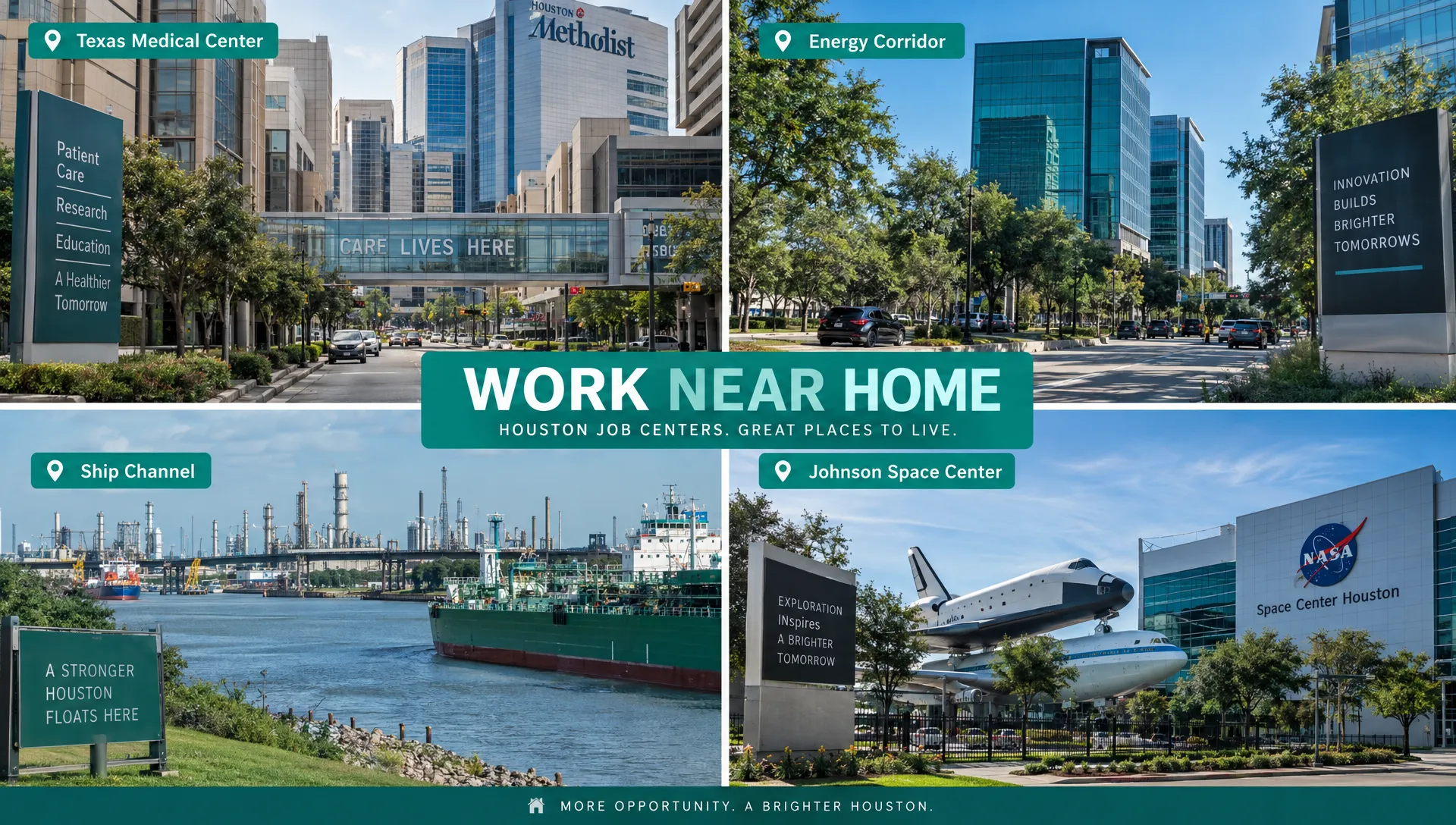
The following locations offer starting points for research, not a ranking of investment returns. Each corridor contains different workplaces, housing options and commute constraints.
| Employment center | Nearby locations to investigate | Potential mid-term housing need | Main property-fit question |
|---|---|---|---|
| Texas Medical Center | Medical Center area, Braeswood and nearby south-central neighborhoods | Visiting clinicians, contract staff and relocating employees | Is the commute practical for the specific facility and shift? |
| Downtown Houston | Downtown, Midtown and EaDo | Corporate relocations, consulting assignments and project work | Does the home support both office access and remote work? |
| Energy Corridor and Westchase | West Houston and nearby west-side communities | Energy-sector assignments and relocation stays | Which office campus will the occupant actually use? |
| Houston Ship Channel | East Houston, Pasadena, Deer Park and Baytown | Industrial projects, maintenance assignments and contractor stays | Is the property convenient to the correct facility entrance? |
| George Bush Intercontinental Airport area | North Houston and Humble | Aviation-related assignments and logistics work | How do early shifts, parking and traffic affect daily access? |
| Johnson Space Center area | Clear Lake, Webster and Nassau Bay | Aerospace-related assignments and household relocations | Does the home suit the assignment duration and household size? |
Medical Center and Downtown: different reasons for longer stays
The Texas Medical Center is a major concentration of healthcare, research and education institutions. That concentration creates several possible temporary housing audiences, but owners should avoid treating them as one interchangeable group.
A clinician working nights may prioritize a quiet bedroom, dependable parking and a straightforward drive. A relocating employee with a family may need additional bedrooms and a functional kitchen. Patients and caregivers can also need extended accommodation, although their housing decisions follow treatment schedules rather than employment assignments.
The distinction matters when evaluating rental areas near the Medical Center: the same home may work well for one audience and poorly for another.
Downtown introduces a different set of considerations. Corporate assignments and relocation stays can involve hybrid schedules, making a comfortable work area relevant even when the office is nearby. An apartment within walking distance may suit one occupant, while a household bringing two vehicles may prefer a home farther out with easier parking.
For either location, test the trip to the actual building, not a general landmark. Include garage access, parking charges and the final walk to the workplace when assessing convenience.
Energy Corridor and Westchase: follow the office, not the industry label
“Energy-sector tenant” is too broad to guide a property decision. A person assigned to a west Houston office has different housing needs from someone working at an industrial facility east of the city.
The Energy Corridor and Westchase are useful places to investigate office-based relocation and project demand. However, an employer’s industry does not tell you where an employee will report, how often they will commute or whether the assignment requires furnished housing.
Ask about the worksite and schedule before drawing conclusions from an employer name. A hybrid employee may tolerate a longer commute in exchange for more space. Someone reporting onsite daily may place greater value on a simpler route.
Owners comparing west-side rental areas should also check competing furnished homes with similar bedroom counts and stay lengths. Nearby annual leases are not direct substitutes, and nightly vacation-rental prices do not establish a realistic monthly rent.
Ship Channel communities: project access matters more than a Houston address
The industrial activity associated with Port Houston and the surrounding Ship Channel makes east-side communities worth researching for project-based housing. Potential occupants include specialists and contractors whose assignments require repeated access to a particular facility.
East Houston, Pasadena, Deer Park and Baytown should not be treated as interchangeable. Industrial sites can have designated entrances, security procedures and routes that add time beyond what a basic map estimate suggests. Confirm the reporting location before describing a property as convenient.
For these rental areas, practical considerations can outweigh decorative upgrades: suitable parking, laundry access, a restful sleeping environment and clear occupancy limits all deserve attention. Evaluate traffic and noise at the property rather than assuming every home near an industrial corridor has the same conditions.
Equipment storage is a separate issue from housing. If preparing a property involves temporary storage for renovation materials, this 2026 guide to used shipping containers in Houston explains condition, delivery and site-preparation considerations. Check deed restrictions, permitting and access before choosing on-site storage; a residential lot is not automatically suitable for a container.
Airport and aerospace corridors: two distinct markets
North Houston and Humble can be relevant to assignments connected with George Bush Intercontinental Airport and surrounding logistics operations. Early reporting times, vehicle access and shift schedules can make the practical commute more important than straight-line distance.
Clear Lake, Webster and Nassau Bay offer a separate research area around Johnson Space Center and aerospace-related activity. A relocating household may need room for family life, while an individual on a defined assignment may prefer a smaller furnished property with fewer expenses.
Neither employment cluster guarantees bookings. Owners still need to establish whether temporary workers or relocating households are seeking homes of the size, price and availability they can offer. Treat the job center as a reason to investigate, not as proof that any nearby property will perform well.
Match the property to the assignment
A useful assessment of rental areas connects the location to the home itself. Start with the occupant’s likely daily routine, then decide whether the property removes friction or creates it.
A one-bedroom home may suit a solo professional but be unsuitable for a relocating family. A larger house can accommodate a household, yet its additional utility, furnishing and maintenance costs must be supported by achievable rent. More bedrooms do not automatically produce better net income.
Focus first on functional needs: reliable internet, usable cooking facilities, laundry access, appropriate parking and bedrooms that support restful sleep. For shift workers, evaluate daylight and noise in the sleeping space. For hybrid employees, provide a work surface that does not require clearing the dining table every morning.
Reviewing furnished mid-term rental options in Houston can help you see how homes are presented for longer stays. Use those examples to identify questions about your own property, not to assume another home’s pricing or occupancy will transfer to yours.
Validate demand before buying furniture or setting rent
Build a small evidence file before committing to a furnished strategy. It should connect the property address to identifiable stay needs and realistic competing options.
- Confirm workplace access: Test routes at likely shift times and check parking or facility-entry requirements.
- Compare equivalent homes: Review furnished properties with similar bedrooms, amenities and minimum stays, recording both asking prices and availability.
- Investigate temporary housing needs: Look for assignment, training or relocation activity, then verify whether it generates housing inquiries.
- Model the full cost: Include utilities, internet, furnishing replacement, maintenance, turnover expenses, management and vacancy.
- Check operating restrictions: Review HOA rules, deed restrictions, applicable local requirements, insurance and lease terms.
Asking prices and blocked booking calendars are incomplete evidence. A blocked period might represent a reservation, owner use or maintenance. Likewise, a job posting establishes hiring activity, not necessarily a need for temporary housing.
A conservative financial model should test gaps between stays and a lower-than-expected achievable rent. Compare that result with a traditional lease or a sale if those are genuine alternatives.
This is where local operating experience can help distinguish promising rental areas from properties that only look convenient on a map. Understanding how a Houston property management company adds value can also help owners decide which parts of the assessment they can handle themselves and where they need support.
Match availability to employment schedules
Mid-term demand follows assignment dates, relocation timelines and project milestones. A home available next week may serve a different audience from one available three months from now, even in the same neighborhood.
Track the details behind inquiries: requested move-in date, expected stay length, workplace location, household size and reason an otherwise suitable prospect declined. Apply consistent screening standards and fair housing requirements throughout the process.
Lease terms should explain how extension requests are handled without promising availability that may not exist. An assignment extension can help maintain occupancy, but it can also conflict with a later reservation.
Over time, actual inquiries provide a more useful picture of rental areas than a broad claim that a neighborhood is “hot.” They show whether the mismatch is price, timing, commute or property layout, allowing owners to make a specific adjustment rather than guessing.
Frequently asked questions
Which Houston job center is best for a mid-term rental? There is no universal best location. The strongest fit depends on the property, actual workplace access, competing furnished supply and verified reasons for temporary stays.
Does being near a major employer guarantee occupancy? No. Employees may already live locally, and new hires may choose permanent housing immediately. Employer proximity is a research starting point, not an occupancy forecast.
How close should a rental be to the workplace? Evaluate the complete trip at the occupant’s likely reporting time. Facility entrances, parking and traffic can matter more than mileage. Ask prospects what commute they can accept rather than assuming one threshold fits everyone.
Can an inherited home work as a furnished mid-term rental? Potentially, if its location, condition, layout and operating costs fit identifiable demand. Compare the furnished strategy with an annual lease and a sale before investing in upgrades.
Evaluate your Houston home against real housing needs
The most promising rental areas connect a suitable property with people who have a clear reason to stay for several months. Start with the workplace, test the commute and verify the numbers.
Scott Property Management specializes in furnished rental properties and provides up to $50,000 in property damage protection as standard risk protection. If you are considering a mid-term strategy, discuss your home’s location, layout and availability to assess whether it fits the longer-stay housing needs around Houston’s job centers.