

7 Mid Term Lease Clauses Houston Owners Should Review
A mid term lease should do more than reserve your Houston property for a few months. It should explain who pays for electricity during a hot summer, what happens when a work assignment ends early and how furnished items are documented at move-out. Those details can determine whether a longer stay produces predictable income or an avoidable dispute.
Furnished mid-term rentals commonly accommodate stays of about one to six months, but that description is not a separate legal category that overrides Texas landlord-tenant law. The agreement, property restrictions and applicable laws still matter.
Before signing, review these seven clauses with your property manager and, where legal interpretation is needed, a Texas attorney. This is an owner-focused review guide, not a substitute for a property-specific lease.
1. Lease dates, extensions and holdover
Start with the exact possession date and time, expiration date and move-out deadline. A phrase such as “three-month stay” leaves room for disagreement about whether the tenant receives three calendar months or a fixed number of days.
The agreement should distinguish an extension from a renewal and explain what happens if neither party signs anything before expiration. Does the tenancy end, convert to month-to-month or continue under another written arrangement? Do not assume the answer simply because rent is paid monthly.
Check that this clause identifies:
- The required notice before departure or a renewal decision
- How an extension request must be submitted and accepted
- Whether any changed rent requires a signed amendment
- What happens if the tenant remains after expiration
Your mid term lease should also make clear that asking for additional time does not automatically reserve it. A traveling professional may expect an assignment extension, while you may already have another tenant scheduled.
The scheduling distinction is familiar from travel: an electric cart rental in Terre-de-Haut has both a reservation period and pickup or return arrangements. Furnished housing needs similarly explicit handoff details, but renewal and possession require Texas-specific legal treatment.
For a home you may sell or occupy later, coordinate the notice deadline with that plan. A lease expiration date alone should not be treated as a guarantee of vacant possession on a particular closing day.
2. Rent, payment responsibility and late charges
State the rent amount, due date, accepted payment methods and any recurring charges. If the first or final month is partial, identify the proration method rather than leaving someone to calculate it later.
A mid term lease should also identify who actually owes the money. An employer, relocation company or insurer may help fund the stay, but that does not automatically make it responsible for unpaid rent. The named tenant, authorized occupants and any business signing the agreement should have clearly defined roles.
For example, an employee may expect reimbursement after paying rent. A reimbursement delay should not leave the owner guessing whether the employee or employer is responsible. Have counsel review corporate housing arrangements, guarantees and third-party payment language when applicable.
Late charges deserve particular attention. Under Texas Property Code Section 92.019, a residential late fee must be included in a written lease, must be reasonable and cannot be collected until rent has remained unpaid for two full days after its original due date. That restriction on late fees does not change the stated rent due date.
Also clarify how payments are credited and how returned payments are handled, subject to applicable law. Avoid stacking vaguely described administrative fees onto an overdue balance. A tenant should be able to reconcile the amount requested with the lease and payment history.
3. The mid term lease deposit, furnishings and damage provisions
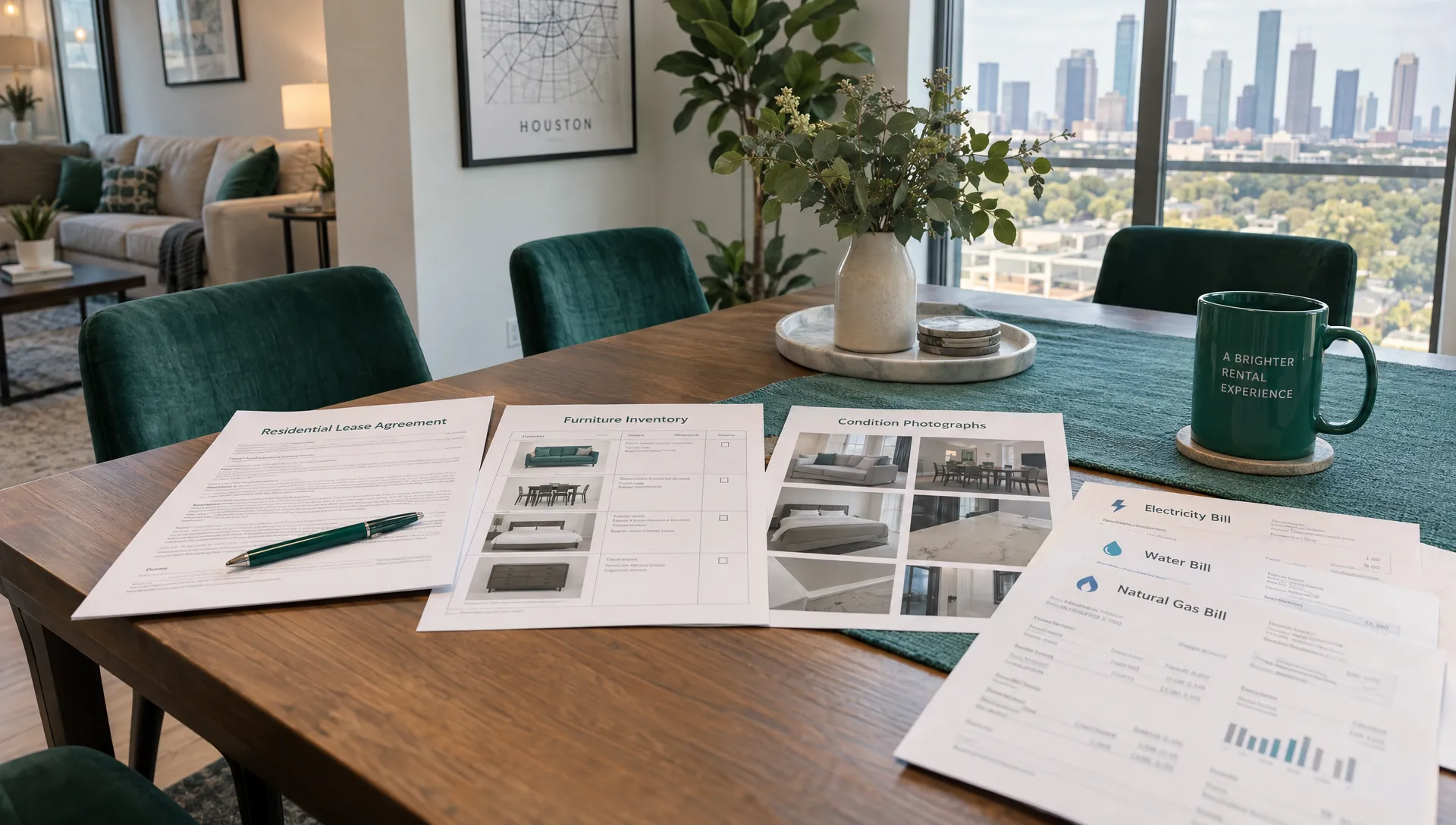
A furnished property needs a condition record that covers more than walls and flooring. Attach an inventory identifying the furniture, appliances, linens and other items included with the home. Date-stamped photographs and a move-in condition report help establish the starting point.
Allow a defined process for reporting missing items or preexisting damage shortly after possession. Keep those reports with the lease rather than scattered across text messages.
The deposit clause should explain its purpose and how deductions will be handled. Under Texas security-deposit rules in Property Code Chapter 92, a landlord generally must refund the security deposit within 30 days after the tenant surrenders the premises, subject to statutory requirements including the tenant providing a written forwarding address. Normal wear and tear is not a permissible deduction.
Distinguish damage from ordinary use. A broken dining chair and a sofa showing reasonable wear after occupancy are not the same issue. Avoid language suggesting that every item can be replaced at full new-retail cost regardless of age or condition.
Finally, separate the tenant’s deposit from any owner-facing damage protection. Scott Property Management provides up to $50,000 in property damage protection as standard risk protection. Ask for the applicable terms and claims requirements; do not assume that protection eliminates the need for documentation or covers every potential loss.
4. Included utilities, usage allowances and billing
An all-inclusive mid term lease can be convenient, but “utilities included” needs a precise definition. List the services supplied, the party holding each account and any lawful limits on the owner’s contribution.
Houston cooling costs make electricity particularly important. A flat rental price should reflect expected seasonal expenses. If the agreement includes an allowance or excess-usage charge, the calculation must be understandable and consistent with applicable utility-billing rules.
| Item | What the clause should clarify |
|---|---|
| Electricity | Whether it is fully included or subject to a defined allowance |
| Water and sewer | Who pays and how any permitted allocation is calculated |
| Internet | The included service and responsibility for optional upgrades |
| Excess charges | Supporting records, billing period and payment deadline |
Avoid a broad statement allowing the owner to charge “excessive usage” at their discretion. The tenant should know what triggers a charge and how it is calculated. Keep actual bills and account for billing cycles that overlap two tenancies.
Do not treat utility shutoff as a collection tool. Texas law restricts interruption of residential utility services, and a lease cannot simply authorize unlawful shutoffs.
Also explain the process for reporting an outage. A neighborhood power failure is different from a malfunctioning breaker or unpaid account. Setting expectations about communication helps without promising uninterrupted service that the owner cannot control.
5. Maintenance, access and emergency response
A multi-month tenant lives in the property long enough to encounter maintenance issues that a weekend guest might never notice. The agreement should identify how to report routine repairs, whom to contact after hours and what qualifies as an emergency.
Separate tenant housekeeping from the owner’s maintenance obligations. Instructions about trash removal, proper appliance use and reporting leaks can be useful. A sweeping clause making the tenant responsible for every repair is not an appropriate substitute for reviewing Texas repair obligations.
For Houston properties, address water intrusion, air-conditioning failures and storm-related problems. Give tenants a practical reporting process and explain which immediate protective steps are appropriate when safe. Do not require them to perform hazardous repairs or assume responsibility for building systems.
Entry language should identify permitted purposes, such as repairs, inspections or agreed showings. State the notice and scheduling process for nonemergency access, along with emergency exceptions. Avoid claiming that Texas imposes a universal 24-hour notice requirement for every residential entry; the lease and specific circumstances matter.
Your mid term lease should make access predictable without treating the tenant’s home as an unrestricted inspection site. If you intend to market an inherited property or list the home for sale during occupancy, discuss showing arrangements before signing. Reasonable scheduling expectations are easier to establish at move-in than during a disagreement over a last-minute appointment.
6. Authorized occupants, guests, pets and property use
Name the approved occupants and distinguish them from temporary visitors. In employer-funded housing, identify the people permitted to live in the home rather than allowing an undefined business customer to rotate occupants without approval.
Guest provisions should explain when an extended visit requires written consent. Apply occupancy standards consistently and have them reviewed for fair-housing compliance. Rules should address legitimate property concerns rather than preferences about who should live there.
Specify whether assignment, subletting or advertising the property on another rental platform requires permission. An owner expecting one relocating household should not discover that the home has been offered for nightly bookings.
Pet terms should identify approved animals, applicable charges and responsibility for damage. Keep those rules separate from disability-related accommodation procedures. HUD’s guidance on assistance animals explains that assistance animals are not pets; qualifying accommodations can include exceptions to pet restrictions and pet fees.
Parking and storage also deserve clear boundaries. Identify approved spaces, any garage exclusions and restrictions that arise from applicable association rules. If an inherited home still contains personal belongings, remove them or document any secured areas excluded from the rental.
A mid term lease should describe the permitted residential use without promising that the arrangement is automatically allowed everywhere. Check applicable deed restrictions, condominium or HOA documents, insurance requirements and local rules for the actual property. A stay exceeding 30 days does not, by itself, resolve every restriction or compliance question.
7. Early departure, termination rights and remaining rent
A tenant’s temporary housing need can change quickly. A medical assignment may be canceled, a new home may close early or an employer may transfer the occupant elsewhere. The agreement should explain how an early departure request is handled.
Distinguish a negotiated early-termination option from simply moving out before the lease ends. If an optional termination provision is offered, specify the required notice, payment terms and conditions for release. Have a Texas attorney review the language, particularly if it combines a termination payment, reletting charge and continuing rent obligations.
Texas law also affects the owner’s response to abandonment. Property Code Section 91.006 requires a landlord to mitigate damages when a tenant abandons the premises in violation of the lease. A lease provision purporting to waive that duty is void.
Separately, certain tenants have statutory termination rights, including qualifying situations involving family violence, specified sexual offenses or stalking, and military service. A general “no early termination” sentence cannot erase rights provided by applicable law.
The mid term lease should therefore distinguish ordinary changes of plans from legally protected termination. It should also establish where notices must be sent and how surrender of possession is documented.
For owners, keep records of communications, marketing efforts, replacement occupancy and any amounts collected. Do not assume that a fixed end date permits charging the departing tenant every remaining dollar regardless of what happens afterward.
Frequently asked questions
How long should a furnished mid-term agreement last? Match the term to the tenant’s documented housing need and your plans for the property. Stays of roughly one to six months are common in this market, but no single duration works for every home. Include a clear process for requesting more time.
Can I write my own rental agreement? You can prepare proposed terms, but a furnished rental involves deposits, inventory, utilities and residential tenant protections. A Texas attorney’s review can help identify conflicts and missing provisions. An online vacation-rental template may not address the tenancy correctly.
Does the agreement automatically become month-to-month? Do not assume it does. Review the expiration, renewal, notice and holdover provisions together with applicable Texas law. If you want extensions to require written approval, have that intention properly reflected in the agreement.
Is a mid term lease enough to protect a furnished home? No. The agreement works alongside screening, condition records, appropriate insurance, maintenance and consistent administration. A well-written clause is less useful if no one documents the inventory or follows the notice process.
Review the agreement before accepting the next stay
Before committing to another furnished tenancy, compare your agreement with how the property actually operates. Confirm that rent, utility billing, inventory records and extension procedures all tell the same story.
Scott Property Management specializes in furnished rental properties. If you want help evaluating the operational side of your arrangement, explore its approach to mid-term rental management or discuss your property with Scott Property Management. Pair that management review with Texas legal advice where needed, especially before changing lease language or relying on an unfamiliar termination provision.